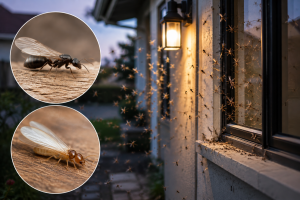
One moment the patio is clear. The next, dozens of winged insects are circling an outside light, collecting against a window or dropping their wings across the floor. Around South African homes, this often happens during warmer weather and after seasonal rain. The immediate assumption is usually “flying ants”, but that is not always correct.
Some may be termite alates, the reproductive members of an established colony. Their role is to leave the nest, pair up and find a place to begin another colony. Flying ants also swarm to reproduce, which is why the two insects can look remarkably similar from a distance. Correct identification matters because ant and termite problems require different treatment.
Start with the Body Shape
The waist is one of the easiest features to compare.
A flying ant has a clearly segmented body with a narrow, pinched waist between its middle section and abdomen. A winged termite has a broader, more uniform body without the same noticeable narrowing. Viewed from above, the termite usually appears straighter from head to abdomen.
Colour is less helpful on its own. Ants and termite swarmer’s can both appear brown, black or somewhere in between, depending on the species. Body shape provides a more dependable clue.
Compare the Wings
Both insects have four wings, but their proportions differ. A flying ant’s front wings are visibly longer than its back wings. A termite swarmer generally has two pairs that are similar in length and shape. Termite wings are often pale or translucent and may extend beyond the body.
Termites shed these wings soon after landing. A collection of loose, matching wings on a windowsill, near a door, beneath a light fitting or beside a skirting board deserves attention, even when no live insects remain.
Look at the Antennae
A close look at the antennae can settle the question. Flying ants have bent or elbowed antennae. Termite antennae are straighter and may have a beaded appearance. This detail can be difficult to see while the insects are moving, so placing a dead specimen in a clear container may make identification easier.
Avoid crushing every insect before taking a closer look. Keeping one or two intact specimens can help a pest control technician confirm what you are dealing with.
Where Did the Swarm Appear?
Location adds useful context. A swarm outside near garden soil does not automatically mean the building is infested. It does, however, indicate that a mature colony may be active nearby.
A large indoor swarm is more concerning, particularly when insects appear to emerge from a wall, floor joint, cupboard, wooden fitting or another part of the structure. Wings accumulating inside without an obvious open window may also suggest that the insects originated within or very close to the property.
Harvester termites are found across most South African provinces and live in underground colonies. Their winged adults appear temporarily when seasonal and atmospheric conditions trigger dispersal.
Do Not Treat Before You Identify
Spraying the visible swarm may kill the insects in the room, but it does not reveal where they came from or whether a colony is affecting the property. Using the wrong treatment can waste time while concealed activity continues.
Take photographs, save a specimen if possible and note where the swarm first appeared. Check for other warning signs such as mud tubes, damaged timber, hollow-sounding wood, lawn deterioration or repeated deposits of wings.
Get Certainty Before Damage Spreads
A swarm may last only a short time, but the colony behind it could have been present for much longer. Pestatermite provides professional ant and termite control services across Gauteng, with inspections used to identify the pest and determine an appropriate response.
When winged insects suddenly appear around your property, do not rely on guesswork. Contact Pestatermite to confirm whether you are seeing flying ants or termites and address the source before the problem becomes more difficult to manage.